Español Español




|
All about Neem
Neem or Margosa is a botanical cousin of
mahogany. It belongs to the family Meliaceae. The latinized name of
Neem - Azadirachta indica - is derived from the Persian, which
literally means: "The Free Tree of India".
In India, the tree is variously known as "Divine
Tree," "Heal All," "Nature's Drugstore," "Village Pharmacy" and
"Panacea for all diseases." Products made from neem have proven
medicinal properties, being anthelmintic, antifungal, antidiabetic,
antibacterial, antiviral, anti-fertility, and sedative. It is
considered a major component in Ayurvedic medicine and is
particularly prescribed for skin disease.
The National Research Council (NRC), Washington,
USA, has released a report with title as " Neem: Tree for Solving
Global Problems." (view the video). The NRC
Panel considers the Neem to be " one of the most promising of all
plants and the fact that it may eventually benefit every person on
this planet. Probably no other plant yields as many strange and
varied products or has as many exploitable by-products. ".
United Nations has declared Neem as the tree of the 21st Century
The Indian neem tree is considered as one of the most
promising trees of the 21st century. It shows great potential in the
fields of medicine, pest management and agriculture. The neem tree
has been known as a wonder tree in India for centuries.
 As this remarkable tree begins to reveal its secrets to modern
science, it should be pointed out that there was a lot of hype
created around neem in the early 1990s, especially in America and
Europe. American companies like W.R. Grace and Agridyne tried to
register over 50 patents related to neem. Such action caused
widespread criticism as it would have colonized the use of neem in
India by first world corporations. In the meantime, courts have
overturned earlier acceptance of such patents because legally, one
cannot protect the rights to a plant.
As this remarkable tree begins to reveal its secrets to modern
science, it should be pointed out that there was a lot of hype
created around neem in the early 1990s, especially in America and
Europe. American companies like W.R. Grace and Agridyne tried to
register over 50 patents related to neem. Such action caused
widespread criticism as it would have colonized the use of neem in
India by first world corporations. In the meantime, courts have
overturned earlier acceptance of such patents because legally, one
cannot protect the rights to a plant.
Neem (Azadirachta indica) is not only known for
its herbal medicines and environmental friendly organic pesticides
but also for its capabilities to balance ecological problems like
deforestation, erosion and global warming. Owing to its
capabilities, United Nations has rightly declared neem as "Tree of
the 21st Century". Thanks to neem that has served our mankind from
almost of the very beginning of known human history.
The neem tree exemplifies Mahatma Gandhi’s
concept of Economy of permanence and has much to offer in solving
global, agricultural, environmental and public health problems. The
commercial and Industrial prospects of Neem are unlimited and
exciting. Speedy realization of its economic potential should be a
priority for all those involved in the Green movement.
The history of the Neem tree
Neem – the legendary medicinal tree
of India, has grown with the human settlement all over the country
and has been an integral part of the Indian way of life for
centuries. The history of the Neem tree is inextricably linked to
the history of the Indian civilization.
The Neem tree has for a very long time been a
friend and protector of the Indian villager. For ages Indians have
trusted this tree to fortify their health and remedy scores of
diseases. In addition, it has been used for protecting food and
stored grains and as a fertilizer and natural pesticide for the
fields. It has been used for a far wider array of uses than any
other tree!
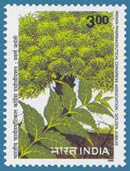 The Neem tree (Azadirachta indica A. Juss) was probably India’s best
kept secret ! Ancient India was envied for its Black Pepper,
Cardamom, Saffron, Turmeric, Sandalwood, Silk etc. and these prized
ingredients were sought after and taken across the seas to Europe
for centuries. The British Raj also failed to grasp the significance
of the presence of this tree in every nook and corner of India
(barring the Himalayas and the costal regions). Perhaps, if they had
known about the wonderful array of uses of the Neem Tree, it would
have become a worldwide phenomenon ages ago !!
The Neem tree (Azadirachta indica A. Juss) was probably India’s best
kept secret ! Ancient India was envied for its Black Pepper,
Cardamom, Saffron, Turmeric, Sandalwood, Silk etc. and these prized
ingredients were sought after and taken across the seas to Europe
for centuries. The British Raj also failed to grasp the significance
of the presence of this tree in every nook and corner of India
(barring the Himalayas and the costal regions). Perhaps, if they had
known about the wonderful array of uses of the Neem Tree, it would
have become a worldwide phenomenon ages ago !!
For Indians, the Neem tree had many fascinating
aspects. For the children this evergreen, attractive tree was a
haven from sun and rain - they spent hours in its cooling shade,
plucked the sweet ripe fruit for a snack and built tree houses,
which they shared with butterflies, birds and bees. This tree was
the chosen one because its shade is known to be cooler than any
other tree's, and also, no bugs or insects are to be found under it
because of its repellant action.
For the women, the neem was the mainstay of the
herbal beauty tradition. It was also a source of medicine to treat
more than a 100 health problems, from scratches and skin rashes to
malaria and diabetes. The women also used it to protect their stored
grains and pulses through the year.
For the men folk the tree provided seeds, leaf
and bark which could be converted into fertilizer and pest control
material. It also provided medicinal potions for their cattle and
livestock. Besides, the breeze that blew through the boughs of the
tree kept their homes free of bacteria and viruses and cool through
the summer.
For centuries Indians planted this tree in the
vicinity of their homes and practiced gentle and daily interaction
with this extraordinary plant. For women in particular, the Neem
proved an invaluable source of health, hygiene and beauty that was
freely available. Having a bath with a decoction of neem leaves kept
their skin supple and healthy. Neem leaf powder or crushed leaves
incorporated into their face packs provided emollient and anti
ageing action. The antiseptic properties of neem leaf extracts
helped in controlling pimples and acne.
In some parts of India, it was a regular practice
to apply coryllium (lamp black) along the side of the eye,
particularly by young ladies as a beauty aid to make eyes
conspicuous. The common method employed to make lamp black was to
take an earthen lamp and put neem oil and a cotton wick in it. When
ignited, the wick liberated copious smoke from which lamp black
could be collected, by placing a brass cup containing water for
cooling, some distance away from the flame. The lamp black deposit
was then scraped from underneath the cup and mixed with a small
quantity of mustard oil to form a thick paste called Kaajal.
Neem oil was believed to prevent baldness and
greying of hair and was used as anti-lice and anti-dandruff
treatment. A teaspoon of dried neem leaf powder, mixed with the same
quantity of ghee (clarified butter) and honey was known to help
control skin allergies.
A mixture of equal quantities of neem seed
powder, rock salt and alum mixed well was used for maintaining
healthy teeth and gums.
Nimba, the great medicine
for the cure of pitta - aggravations and
for blood purification
- Priyanighantu Harotakyadivarga
All these practices have been validated by modern
science. We know today that this extraordinary tree can do all that
it can do because of the sheer range of compounds present in it. A
132 to be precise have been identified to date. Modern research has
uncovered the secret of its effectiveness. Its powerful
antibacterial, anti-fungal, antiviral and antiseptic properties make
it particularly effective in treating anything from dandruff to
acne, eczema to malaria and cold sores to warts! Ironically, it is
this very versatility that for so long has kept this tree and its
amazing properties from taking center stage. The mindset that
consumers have been shaped into dictates that there has to be a
specialist solution to each problem, in order for the solution to be
effective. That one tree can solve so many diverse problems is
simply suspect in today's market.
 The word NEEM is derived from Sanskrit Nimba which means ‘bestower
of good health’. It has also been known as Ravisambha – sun ray like
effects in providing health. The Neem tree has been venerated
through the ages in the Indian countryside as it provided hope in
any situation and the faith in the miraculous healing powers of this
amazing tree led patients with incurable diseases to adopt neem as
way life. They lived in the shade of the tree, drank infusion of
various part (Leaf, bark, etc) as advised by Ayurvedic tradition.
They used young twigs for oral hygiene first thing in the morning,
ate tender leaves as salad or cooked leaves with vegetable as food.
Neem gums was used as lozenges for dryness of throat and allay
thirst. In summer, sweet, ripe fruit were sucked for their sweetish
pulp. All this together, probably strengthened their immune system
to meet any challenge!!!
The word NEEM is derived from Sanskrit Nimba which means ‘bestower
of good health’. It has also been known as Ravisambha – sun ray like
effects in providing health. The Neem tree has been venerated
through the ages in the Indian countryside as it provided hope in
any situation and the faith in the miraculous healing powers of this
amazing tree led patients with incurable diseases to adopt neem as
way life. They lived in the shade of the tree, drank infusion of
various part (Leaf, bark, etc) as advised by Ayurvedic tradition.
They used young twigs for oral hygiene first thing in the morning,
ate tender leaves as salad or cooked leaves with vegetable as food.
Neem gums was used as lozenges for dryness of throat and allay
thirst. In summer, sweet, ripe fruit were sucked for their sweetish
pulp. All this together, probably strengthened their immune system
to meet any challenge!!!
Its medicinal properties are documented in the
ancient Sanskrit texts – puranas and it is estimated that Neem is
present, in one form or another, in 75% of Ayurvedic formulations.
The ancient Indian found many therapeutic uses
for the tree and also observed that the tree could survive and grow
almost anywhere as long as it was warm and dry. In due course of
time, migrating Indians carried it to distant lands ie: Africa,
Fiji, Mauritius, Malaysia, Indonesia, Thailand, Cambodia,
plantations are reported to be making headway in USA, Mexico,
Australia and China and several countries of Latin America.
Neem Oil is generally recommended for skin
diseases while neem leaves are used for beauty purposes.
The Neem leaf extracts have a powerful
antiseptic, antifungal, antiviral and anti-bacterial effect. unlike
synthetic chemicals that often produce side effects such as allergic
reactions, rashes etc. Neem is gentle and does not create any
complications.
Unlike Neem seed oil, Neem leaves have a pleasant
odour. An extract from neem leaves can be prepared as an alcoholic
tincture or as tea. The alcohol extract has a dark green colour and
is effective for several weeks. It can be used in anti ageing
nourishing formulas, mouthwashes, facewashes, shower gels, soothing
gels, face masks, skin toners etc
Did you know?
• The Vedas called Neem sarva roga nivarini, which means ‘one that
cures all ailments and ills’.
• This tree is considered to be of divine origin, According to
Indian mythology, amrita (ambrosia or the elixir of immortality) was
being carried to heaven and a few drops of it fell on the Neem tree.
• Another story tells of the time the Sun took refuge in the Neem
Tree to escape from the awesome powers of the demons.
• Planting three or more Neem trees during one’s lifetime was
considered a surefire ticket to heaven.
Resource:
Neem Foundation, Mumbai, India. "Neem: History of Usage".
|
Buy Neem Online
More information:
Neem & acne
Neem - contraceptive
Neem & cholesterol
Neem & diabetes
Neem & herpes
Neem & hypertension
Neem & malaria
Neem & pets
Neem & psoriasis
|